
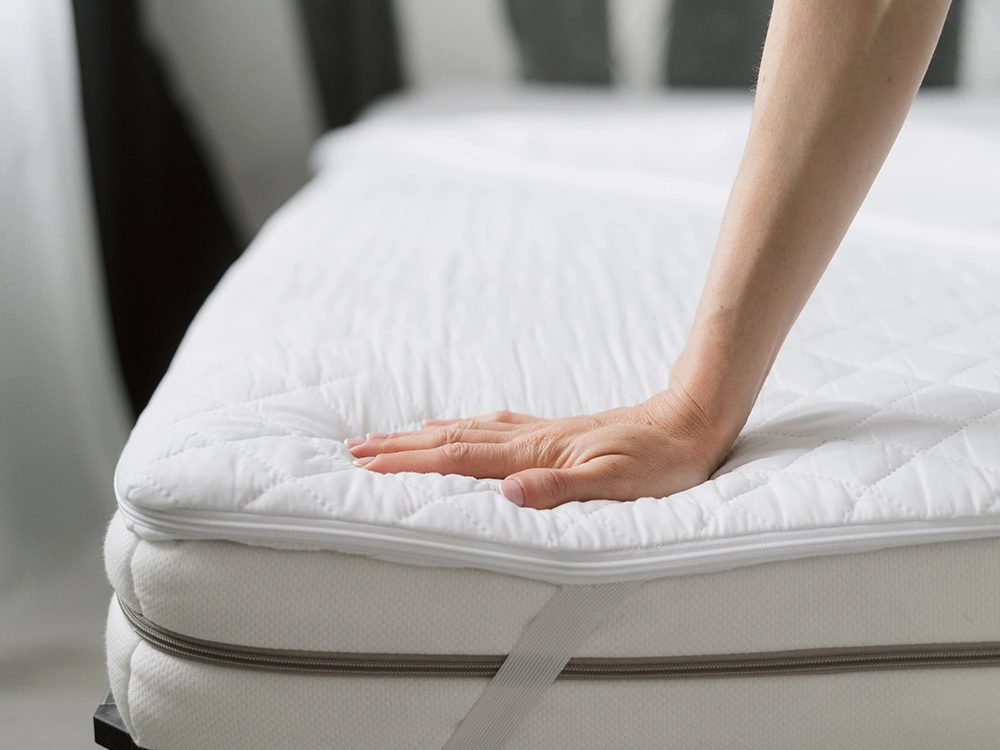
TPU Film for Medical Mattress Covers and Hospital Bed Surfaces
Barrier, Disinfectant Resistance and Seam Integrity Under Daily Use
TPU film for medical mattress covers is specified for three properties that ordinary film cannot combine: a continuous fluid barrier, resistance to repeated disinfection, and a seam that stays sealed through flexing and laundering.
A cover that fails any one of those becomes an infection control problem rather than a durability complaint.
This article covers the functional requirements, the construction choices, the cleaning agents that cause premature failure, and the tests that predict whether a cover survives a hospital laundry.
What a Mattress Cover Has to Do
The cover separates the mattress interior from everything the patient brings to it. That means blocking liquids under pressure, tolerating repeated cleaning, and surviving the mechanical load of a moving patient.
The barrier has to hold under load, not only under a drop of liquid. A patient's weight concentrates pressure at the pelvis and heels, and a film that passes a static test can still leak at a fold under 80 kilograms.
Friction and abrasion matter as much as strength. A cover that resists tearing but abrades through at the edges will develop pinholes that are invisible until a mattress is contaminated.
Comfort is a clinical requirement rather than a luxury. A cover that is noisy, tacky or hot affects sleep and patient compliance, and those properties come from the film surface rather than from the barrier layer.
Fluid Barrier and Seam Integrity
The film itself is rarely the leak point. Seams, zip attachments and the boundary where the cover meets the mattress are where fluid gets through, and they deserve more attention than the base material.
A welded seam is continuous and does not create a stitch hole, which is why heat sealed and high frequency welded constructions dominate. A sewn seam requires a sealing tape over the stitch line, and the tape is only as good as its bond.
Zip closures are the weakest point in a removable cover. A water-resistant zip with a sealed flap is better than a standard zip, and the flap has to be positioned so that fluid running down the side cannot reach the teeth.
Seam testing should be done on the finished cover under pressure, not on a flat specimen. A hydrostatic test on a seam that has been folded and flexed is far more informative than a flat peel test.
Disinfectants and Chemical Attack
Hospital cleaning agents are the most underestimated cause of cover failure. Chlorine releasing solutions, quaternary ammonium compounds, alcohols and peroxide based products all attack polymers in different ways.
Repeated exposure causes crazing, colour change and a loss of elongation that appears as cracking at the folds. The damage is cumulative, so a cover can pass a single wipe test and fail after two hundred cycles.
Polyether-based TPU generally resists hydrolysis better in a wet environment, while polyester grades offer better resistance to some oils. The right choice depends on the cleaning regime, which is why the agent list should be part of the specification.
Ask the customer for the actual products and concentrations used, not a general description. "Hospital disinfectant" covers a wide range of chemistries, and the difference between them determines whether the cover lasts two years or six months.
Breathability, Heat and Patient Comfort
A fully sealed cover traps moisture, and trapped moisture is both a comfort problem and a skin integrity risk. That is why breathable constructions are specified for long-stay and pressure relief surfaces.
Water vapour transmission and liquid barrier are not contradictory. A hydrophilic TPU film can pass vapour while remaining continuous, and the transmission rate is set by the grade and the thickness rather than by perforation.
Perforated film is a different approach and a different risk. Holes that pass vapour also pass liquid, so a perforated cover depends on a backing layer that has to remain intact through washing.
Surface feel also matters. A matte finish reduces tackiness against skin and lowers the noise of movement, which matters on a ward where several beds share a room.
Mattress Types and What Changes
A standard ward mattress, an alternating pressure system and an ICU bed put different demands on a cover. The ward mattress is mostly about cleaning and abrasion, while a pressure relief surface adds continuous flexing at the cell boundaries.
Alternating pressure mattresses are the hardest case for a film. The surface moves constantly, so the cover sees millions of small flex cycles over its life and any stress concentration at a seam becomes a crack.
ICU and operating table surfaces add chemical exposure from skin preparations and cleaning agents, and they often use a thinner cover because the surface must transmit pressure changes quickly.
Trolley and equipment covers are a lighter duty, and unsupported film is common there because comfort and noise matter less than barrier and cost. Specifying the same construction across all of these is a false economy.
Comparing Cover Constructions
| Construction | Strength | Limitation |
|---|---|---|
| TPU film laminated to fabric | Soft hand, quiet, good drape | Lamination bond is a failure point |
| Coated fabric | Lower cost, familiar process | Coating can crack at folds |
| Unsupported TPU film | Maximum barrier, easy to weld | Can be noisy and less comfortable |
| Breathable TPU film | Vapour transmission with liquid barrier | Higher cost, lower mechanical strength |
| Multilayer TPU construction | Balanced barrier and toughness | Harder to recycle, more process steps |
Most hospital covers use a laminated or coated construction because comfort and noise matter in a ward. Unsupported film is more common on trolley mattresses and equipment covers where the patient does not lie for long periods.
Laundering and Durability Testing
Test against the laundry protocol the cover will actually meet, not a domestic cycle. Hospital laundering uses higher temperatures, stronger chemistry and mechanical action that a domestic test does not reproduce.
- Cycle count, temperature and detergent chemistry as used in the actual laundry
- Disinfectant wipe cycles at the concentration the ward uses
- Hydrostatic resistance on seams after the full cycle count
- Tensile and elongation retention compared with the original values
- Visual inspection for crazing, colour change and surface tackiness
Retain the tested covers with the cycle record. When a ward reports failure at eighteen months, the retained sample shows whether the film degraded or the cleaning regime changed.
A Specification Checklist
- State the mattress type and the pressure relief requirement
- List the disinfectants and concentrations used on the ward
- Define the laundry protocol and the required cycle count
- Specify the seam method and the closure type, not only the film
- Agree the barrier test and the acceptance criteria before the first order
Biocompatibility for medical use is demonstrated on the finished device rather than on the raw film. Standards such as ISO 10993 describe the test methods, and the assessment depends on contact type and duration.
The medical supplies range is described on the medical supplies product page, which sets out the film constructions used for mattress covers and similar surfaces.
Zhejiang Huanlong New Material Science Technology Co.,Ltd produces TPU film on 44 lines across three manufacturing bases, with two R&D centres and more than 30 engineers. Huanlong holds OEKO-TEX® 100, Bluesign®, GRS and ISO 9001:2015 certification, and can supply film for medical mattress cover construction.
The short version: the film is the easy part; seams, zips and disinfectant chemistry decide whether a cover survives. Test a finished cover against the real laundry and cleaning protocol.
A mattress cover fails at a fold, a seam or a zip long before it fails in the middle of a panel.
Frequently Asked Questions About TPU Film for Medical Mattress Covers
What thickness is used for mattress covers?
It depends on whether the film is unsupported or laminated. Unsupported covers usually need a heavier gauge for puncture resistance, while laminated constructions can use a thinner functional layer because the fabric carries the mechanical load.
Can a TPU cover be breathable and waterproof?
Yes. A hydrophilic TPU film passes water vapour while staying continuous, so it blocks liquid without perforation. The transmission rate depends on grade and thickness.
Which disinfectants attack TPU?
Concentrated chlorine releasing solutions and some solvent-based products cause the most damage, particularly at folds where stress concentrates. The specific product and concentration should always be tested against the specific grade.
Should the cover be welded or sewn?
Welded seams give a continuous barrier without stitch holes and are preferred where the cover must be fluid proof. Sewn seams need a sealed tape over the stitch line and a bond that survives laundering.
How long should a hospital mattress cover last?
It is normally defined by a cycle count rather than by years, because laundering and disinfection drive the ageing. A cover specified for a defined number of industrial wash cycles can be assessed objectively at the end of that period.
Send the mattress type, the cleaning agents and the laundry protocol, and a construction can be proposed for TPU film for medical mattress covers. Huanlong can supply film and lamination options for healthcare surfaces.
See How the Film Is Made Ask About TPU Film for Medical Mattress